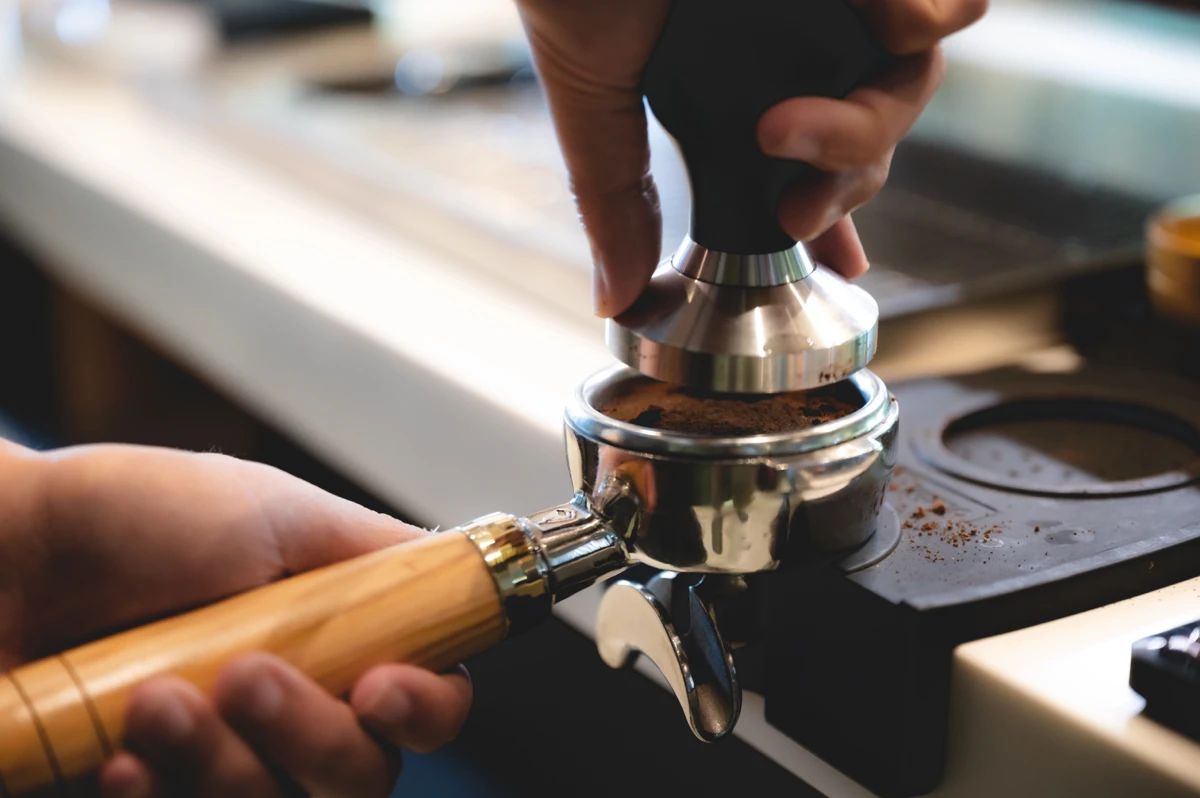
While tamping espresso coffee in the portafilter seems straightforward, there are a few important things to remember as you press the tamper down onto your freshly ground coffee. Here are some frequently asked questions about espresso tamping to consider.
Frequently Asked Questions About
Tamping Espresso Coffee
How hard should I tamp my espresso?
The widely recommended guideline is to apply around 25–30 pounds of pressure when tamping. To put that in perspective, it feels like a firm, deliberate press — not a forceful shove. What matters most is repeatability. Whether you use a manual or calibrated tamper, consistency across every shot is more important than hitting a precise number. Many home baristas get hung up on a specific number, but the real goal is a perfectly level and evenly compacted puck. You can practice finding the right feel by pressing down on a kitchen scale until it reads between 25 and 30 pounds. Once that pressure feels natural, stick with it every time. That muscle memory is what builds great espresso.
Source: Pro Coffee Gear (https://procoffeegear.com/blogs/articles/tamp-espresso-perfect-pressure) | Seven Sisters Coffee Co. (https://sevensisterscoffee.co.uk/tamping-pressure-how-much/)
What are the consequences of improper tamping?
Tamping too hard or too light both cause problems, but in different ways. If water moves too quickly through the puck, it under-extracts the coffee, producing a sour or weak shot. If it moves too slowly, over-extraction results in a bitter, harsh-tasting espresso. The most common consequence of uneven tamping is channeling. Channeling occurs when water flows unevenly through the coffee puck, creating some areas that are over-extracted and bitter while others remain under-extracted and sour. Shots that channel often have contradictory flavors simultaneously, with weak body and muted notes. Even a tamp that looks fine on the surface can hide internal density problems that ruin the shot. Consistent, level tamping is your best defense.
Source: Espresso Outlet LLC (https://espressooutlet.com/blogs/blog-articles/tamping-pressure-and-espresso-extraction-a-detailed-guide) | Manny's Gelato & Cafe (https://mannysgelatoandcafe.com/espresso-channeling-2/)
How can I ensure an even tamp for my espresso shots?
Even tamping starts before the tamper touches the grounds. Use a distribution tool like a WDT (Weiss Distribution Technique) tool to break up clumps and create a level coffee bed before tamping. A level surface before tamping significantly reduces the risk of channeling and improves extraction uniformity. From there, grip your tamper like a doorknob, align your wrist straight, and press down squarely. After tamping, check that the surface is flat and even. A tilted or uneven surface can result in imbalanced extraction. Avoid pressing twice — if you catch a mistake, it is better to start over than to double-tamp. With consistent prep habits and a level press each time, even shots become the norm rather than the exception.
Source: Manny's Gelato & Cafe (https://mannysgelatoandcafe.com/espresso-channeling-2/) | Ursae Cafe (https://ursae.ca/en/blogs/letoile-du-matin/la-force-de-tamping-pour-un-espresso-parfait-guide-pour-machines-manuelles)
Should I use a tamper or my hands to tamp espresso?
Always use a proper tamper. Your hands simply cannot apply consistent, flat pressure across the entire coffee bed. If your espresso machine came with a lightweight plastic tamper, it does not have the heft needed to tamp properly. Upgrading to a heavier, well-built tamper makes a real difference. In a pinch, some people use a jar or other cylindrical object that fits the portafilter, but results will be unpredictable. A solid stainless steel tamper sized to match your portafilter basket — typically 54mm or 58mm — gives you the control and weight you need for a flat, repeatable press. Ultimately, the ideal tamper does more than just guide the process. It sets the rhythm for a consistently great espresso shot.
Source: HomeGrounds (https://www.homegrounds.co/how-to-tamp-espresso/) | Breville (https://www.breville.com/us/en/blog/coffee-and-espresso/how-to-tamp-espresso.html)
What tools can help me achieve the perfect tamping pressure?
A few affordable tools make a big difference. A calibrated tamper is the most impactful upgrade.Calibrated tampers are engineered to deliver a precise amount of pressure — generally around 20–30 pounds — with each press, ensuring consistency and removing guesswork, especially for beginners still developing technique. A WDT tool (a small needle stirrer) levels your grounds before tamping, which cuts down on channeling. A tamping mat gives you a stable, non-slip surface for a steady press. The Normcore Spring-Loaded Tamper is a popular option for beginners, offering three interchangeable springs at 15, 25, and 30 pounds along with an auto-leveling plate to minimize channeling. You do not need to buy everything at once. Start with a quality tamper and add a WDT tool when ready.
Source: Breville (https://www.breville.com/us/en/blog/coffee-and-espresso/how-to-tamp-espresso.html) | The Coffee Folk (https://thecoffeefolk.com/the-best-espresso-tampers/)
Tamping is only half the equation. Uneven grind size causes many of the same channeling problems. See our espresso grinding FAQs for guidance on both variables.